
Freedom, as defined by the Cambridge Dictionary, is “the condition or right of being able or allowed to do, say, think, etc. whatever you want to, without being controlled or limited […]”.1 It can also be defined as the absence of outer forces on our person.2
Following that definition, how free can we be in a world determined by laws, unwritten social rules and expectations, the pressure to be perfect constantly, and having to present yourself as such under the always watchful, judgmental eyes of the internet?
How big does our need for freedom have to be, how tiny our cage, before we feel the need to break free from the world that binds us?
And with those words:
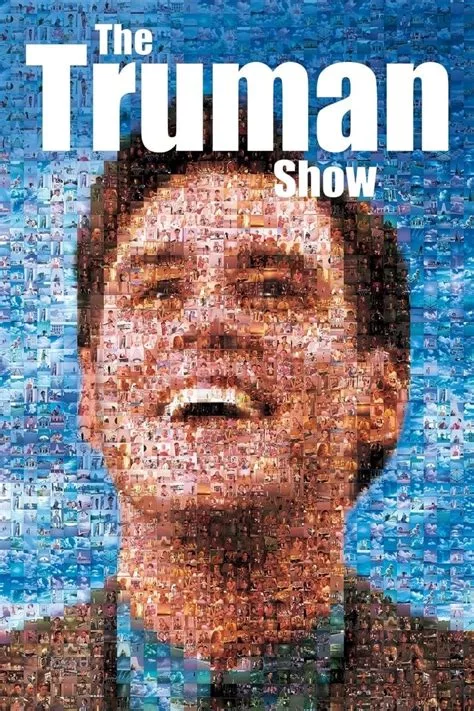
Welcome to my review of “The Truman Show” (1998), directed by Peter Weir
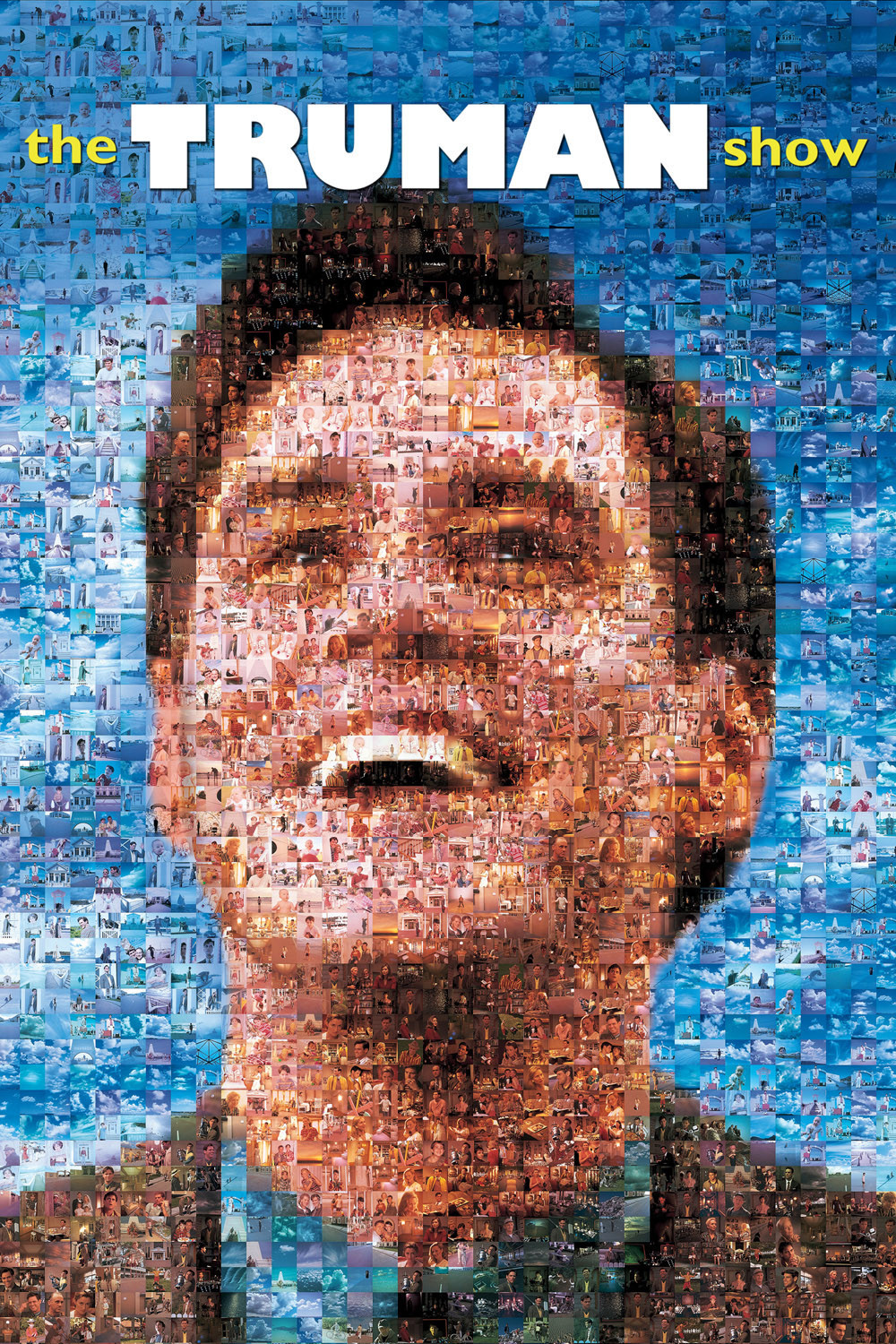
The Truman Show – Movie Poster3
“We Accept The Reality Of The World With Which We’re Presented. It’s As Simple As That.”
List of contents
- Oversight
- Summary
- Plot (spoilers)
- Characters (spoilers)
- Thoughts (spoilers)
- Moments/Scenes that stayed with me (spoilers)
- Pending Play Grading
- Sources
The Truman Show – Still 14
Overview
The Truman Show
1998
103 minutes
English
Comedy, Drama
Director: Peter Weir
Writer: Andrew Niccol
Editors: William M. Anderson, Lee Smith
Jim Carrey, Laura Linney, Noah Emmerich, Natasha McElhone, Holland Taylor, Ed Harris, Paul Giamatti, Brian Delate
(More actors whom I have chosen not to name in favor of brevity and due to their smaller roles. Some of them may be mentioned later on.)
The Truman Show – Still 25
Summary
“The Truman Show” transports us to the seemingly most perfect town in the entire world. Here we meet Truman Burbank (Jim Carrey), a married insurance salesman who dreams of one day traveling the world. When strange things start happening to Truman, and seemingly to only him, he very suddenly has to grasp with the idea that his entire existence, his life and identity, might be a carefully constructed lie, imposed on him by others for their entertainment.
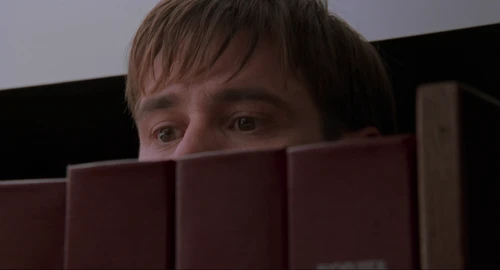
The Truman Show – Still 36
Plot
(spoilers)
Right from the start of the movie, we are introduced to the concept of the show Truman (Jim Carrey) is, at this point, unknowingly the star of, by its creator and director Cristof (Ed Harris). We go into Truman’s life knowing it has been constructed for the entertainment of people from all around the globe. But Truman does not know that yet. Instead, he lives a very ordinary life, driving to his boring salesman job in the morning, buying the daily newspaper and a women’s magazine, working, and then coming home to take care of the house until his wife Meryl Burbank (Laura Linney) gets home. Meryl Burbank is not Truman’s actual wife. Her true name is Hannah Gill, and she, like all the people in the town, is an actress hired by Cristof (Ed Harris) to play a specific person in Truman’s life.
For a while, Truman’s life seems happy. He goes about his daily life, loving his wife, doing his job, and drinking beer with his best friend, Marlon (Noah Emmerich), also an actor whose actual name is Louis Coltrane.
Then all of a sudden, his life is upturned when he spots his supposedly dead father on the street one day. But before Truman has a chance to speak to the man he recognized as his father, the latter is whisked away by, in Truman’s eyes, unrelated strangers.
When he speaks to his mother, Angela Monclair/Alanis Monclair (Holland Taylor), she leads him to believe that Truman simply had a very vivid and heavy grief episode that made him see his father in a stranger. But the doubt has already started residing in Truman; whenever he leaves the house now, he sees all the eyes secretly watching him.
The further he investigates, the more he notices all the things wrong with the world surrounding him. The same people and cars always appear at the same time, buildings he usually does not interact with, having fake elevators, people trying their hardest to stop him, when he follows his wife to work, suspicious that she is lying about her job.
Knowing something is very wrong, Truman tries to leave the city, something he has wanted to do for a while but has always been talked out of by his wife, friends, and coworkers. When any plan he makes to leave the city fails due to not-so-coincidental misfortune, Truman’s uneasiness and his desire to leave grow exponentially.
Remembering a fateful meeting with a woman called Sylvia (Natasha McElhone) in his high school years, in which she tried revealing to him that he was trapped in a fake world that was built solely for him to act in and interact with, Truman decides to escape once and for all.
Luring his wife into the car with him, Truman makes for a swift getaway with her beside him. The more that other cars try to block his road, the more obstacles suddenly appear in his way, the more Truman is validated in his fear that he is, in fact, trapped in some form of simulation that almost all the people around him know about, except for himself, and maybe those closest to him.
When his escape attempt fails, Truman’s best friend tries to comfort him, tries one more time to convince him that he is making everything up. That there is no secret simulation, no elaborate plan. But Truman’s doubt runs too deep. So in order to keep him compliant, Cristof, the director of Truman’s life, decides to bring his father back, seemingly refocusing Truman’s efforts on rebuilding his relationship with his long-lost father.
But Truman is not done yet. While he keeps pretending to play the game, he lives his life accordingly. He establishes a plan to escape, and eventually follows through. Escaping on a boat to the edge of what was his world, where Cristof finally relents and lets Truman leave.
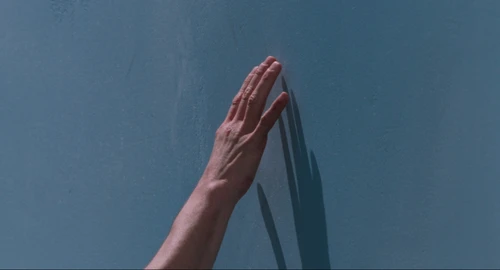
The Truman Show – Still 47
Characters
(spoilers)
Truman Burbank is a youthful and bright adult, married to Meryl Burbank. He lives his day going to his boring insurances salesman job, he buys the daily newspaper, he drinks beer and swings a golf stick with his best friend, Marlon. As constructed, he is an ordinary man.
But Truman is also haunted, by his father’s death. When he gets too close to water, he remembers: going sailing with his father, wanting to keep going in spite of his father saying it is too risky, then the waves, his father’s hand clasping his own, then letting go, then nothing. He comes back to himself, dizzy and terrified, needing steady ground under his feet.
He is also haunted by a special set of eyes. Eyes that he keeps buying the same magazine for everyday, claiming that it is for his wive. Only to tear out the faces of models and try to reconstruct a face he wants desperately to remember. Searching to see a face he once fell in love with, a face that risked not seeing him ever again to tell him the truth about his life. But Truman remembers her, remembers his love and her words, and he is searching for her.
With growing suspicions that he is trapped in some eloquent game that everybody is in on but him, Truman grows increasingly more unhinged. The more he feels watched the greater his desire becomes to leave. His joyful and optimistic attitude, his heartfelt smiles and bright voice starts to feel steadily more manic the harder he tries to break free form the life and world that now feels like his entrapment.
While his desperate desire to leave, gives him a manic, almost insane appearance, it also serves to make him braver. Leading him to overcome his fear of water in order to reach something he desperately wanted all his life, the freedom to go where he desires, to see the rest of the world.
Cristof is an artist at heart, desiring to bring a piece of media, of art, to the world that feels true and not misguided by unfortunate acting performances.
In order to achieve this desire, Cristof creates “The Truman Show”, a show that follows the life of Truman Burbank from his birth throughout everyday of his life. Even goung so far as building a dome onto the Hollywood hills to create another smaller world that is completely apart form the rest of it, just for Truman Burbank to interact with.
Cristof watches Truman, instigating events in his life to get real emotions out of the latter, such as the death of his father, the meeting with the women that would later become his wife. Nothing is as important to Cristof as keeping “The Truman Show” running. In order to do that, he has no problem removing actors from their duty and shutting down the voices of concern about teh ethics of his project from the outside world.
Deep down, it seems, Cristof knows his actions are not compatible with his own sense of morality, but his obsession proves to be more important, more valuable than his own morals, and also more important than the freedom of one man.
Meryl Burbank, Truman’s wife, is nothing more but a character, played by an actress named Hannah Gill. She has the role of the loving and doting wife mastered, at least, almost.
Sometimes when she smiles. You see the forced nature of it, her acting bursting at the seams, trying to bury the person she actually is under the job persona she needs to have, while trying to keep Truman unknowingly in line.
In her role she has spent the larger part of her life at Truman’s side, being introduced into “The Truman Show” as Truman’s love interest in high school. She too is living a great deal of her life in a fake reality, but unlike Truman, she knows this. She does this willingly. To her this is not her life, this is her job.
Albeit being a good actress, she is still a person, and when Truman’s behavior grows increasingly unhinged, it leaves her confused, irritated and in the worst moments so terrified she breaks character. We do not get to see much of her actual character past the persona she was assigned, except for the looks of irritation and the forced smiles.
Louis Coltrane play the role of Marlon, Truman’s best friend. He is fun, a bro, there to listen and support Truman, and most importantly, to dissuade him from his plans to leave the town. He was written into Truman’s life when they were both children, and has remained his best friend through high school all the way into adulthood, and in a carefully orchastrated way, he is also the only “real” friend Truman has.
Marlon works at the supermarket, stocking vending machines, and apparently that really is all his character is supposed to be doing, because when Truman eventually shows up to his work (the script did not plan for that), Coltrane ends up stacking the same items into the vending machines more than once. (Not that Truman noticed.)
When Truman’s life seems to be falling apart, Marlon is the final person he turns to, the one he trusts most. And when Marlon lies to him while stating he would never do that, you can see a flicker of regret flash across the eyes of Louis Coltrane. Because despite Marlon being a role to play, a job, he does care for Truman. But not more than for his job, or the project, or the money he gets out of it, whatever ended up being his biggest motivator in the end.
So when things truly go sideways, and Truman escapes, Coltrane is, like all the other actors, on the street, searching for Truman. To drag him back into the simulation of his life, whether he is willing or not.
Sylvia was supposed to act as Lauren Garland, no more than a background character to Truman’s life in his highschool years. But when their eyes catch across the school yard one fateful day, the attraction is imminent, and it starts a chain reaction Sylvia can not stop, despite desperately trying to.
The show runners see Garland and Truman looking at one another and they wisk Sylvia away, no matter whether that is on the schoolyard or in a dance hall right in front of Truman.
And despite those instances, Garland is kept in the show, and Sylvia specifically told to not interact with Truman anymore. She does not. But that does not stop Truman from seeking her out.
Regardless of how she tries to convince Truman (and herself) that they should not be talking, it is too late, she already likes him, and he likes her. Their forbidden conversation quickly leads to a getaway to the beach where they share a very unintended kiss (unintended by the show runners, that is.)
In a short time Sylvia has grown fond enough of Truman to risk her job one final time, and tell Truman outright that the world he lives in is fake, that all he knows is simulated. She tries her best, but Truman just ends up confused, before she is dragged away by another actor posing as her father, explaining that Lauren has a mental illness, that she cannot be trusted.
So she exits Truman’s world, leaving behind only her true name, the truth Truman cannot yet believe, and eyes that will fill his thoughts well into his adulthood.
When Truman finally realizes his entrapment, Sylvia is glued to the screen, loyally praying for his escape, and pressuring the director with questions on morality, concerning Truman’s situation.
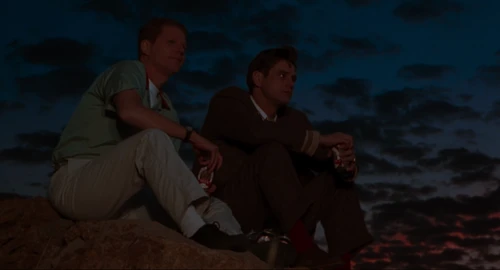
The Truman Show – Still 58
My thoughts
(spoilers)
Now let’s get to the thing you are actually reading this review for (probably): my thoughts.
The premise of the movie is very interesting. Having an actor be born into a movie, so to speak, and then orchestrating his entire life to get “true” reactions out of the person. The very premise of the movie already invites so many questions on morality and philosophy.
Some questions that came to me while interacting with this movie:
- How far are you allowed to go for art? How far is too far?
- When you orchestrate an actor’s entire life, even when that actor does not know they are playing a role. Can any reaction they have truly be authentic, when the environment they are interacting with, the emotions they feel are entirely provoked and controlled? Is that still true and authentic at all?
- In doing this, is it not a violation of a fundamental human right? The right to freedom? How did they manage to get around that?
- Can watching a person’s entire life in real time still be considered entertainment, or does it already border on perversion?
- When you keep someone in a cage, and they try to escape, are you still stopping them in order to achieve your own dream? Or can you finally relent and let go?
- How much gaslighting can a person endure before they cross a line into insanity?
- How far are you willing to go to achieve freedom for yourself? Are you willing to face your demons? Are you willing to overcome your fears?
Here’s a thing about me: I like a movie that makes me think, a movie that stays with me long after the credits have rolled, that comes back to me when I drift into thought on a walk or on the train. “The Truman Show” certainly managed to achieve that.
At the beginning of the movie, I was rather surprised that it started with the director of “The Truman Show” in the movie, explaining the premise and why he created it. It left the viewer with all the information, and Truman with none of it, creating a certain tension of wondering when he was going to find out. When the joyfulness of the movie was going to give way to its more in-depth themes of identity and freedom.
I have to admit it happened rather quickly. I thought they were going to give us more character introductions before starting to make signs appear, at least to Truman. But it did not take five minutes for the first incident, a lamp from the set just falling down from what appeared to Truman as a normal sky, and landing right next to him.
From then on, we are introduced to Truman’s character, how he interacts with the world, his fear of water, and the tragic loss of his father. On his very first routine day, when he bought the women’s magazine from the shop by the road, I fully misunderstood and thought he bought a pornography magazine or something in that direction, and ended up rather confused when all that was in there where faced of women, of which Truman proceeded to rip out the eyes only. Much to my glee, it was revealed later why he did that. So very nice foreshadowing.
In my opinion, the “subtle” or what I would interpret was what were supposed to be subtle hints were already very much not subtle. The lamp falling from the sky. A stream of rain drenching only Truman, and even following him around, before the rest of the rain mechanics catch up. Those were already very unsubtle, and I think it would have made more sense to pick something that was actually more subtle. Like an actor repeating a line or something like that. (There were, of course, mimics and gestures of the actors around Truman, which were subtle.)
The way the actors around Truman were specifically instructed to sell the perfect town picture to him comes across really well. The actors, the actual actors, do a remarkable job at playing bad actors, thus proving the skill they have as actors, by proving the fictional director right in his statement that acting performances often feel hollow. It’s some Inception-type confusion. Basically, what I am trying to say is: Real actors do good job playing bad actors in movie, thus proving fictional point of fictional director that acting feels inauthentic.
Jim Carrey‘s performance is outstanding. From his initial joyful and youthful character to when that joyfulness turns into something forced that borders on insanity. I cannot overstate how incomprehensibly well Jim Carrey‘s “is he going insane or is this still on purpose” worked. For most of the movie, I sat glued to the screen, debating whether Truman was actually just turning crazy or whether he, too, was acting now in order to establish a plan for escape; all thanks to Carrey‘s outstanding performance.
It was not only Jim Carrey. Noah Emmerich and Laura Linney had this equally good acting style or made similar good acting choices where their character’s true personalities slipped out underneath the roles they were assigned. In smiles that seemed a little too bright, looks that strayed a little too far into the fourth wall break, and pauses that lasted just a little too long to be considered natural.
I really, really appreciated the acting choices that were made by the actors in this movie.
Moving on, I think the way that Truman’s gradual growing desperation for leaving made a lot of sense. His attempts that kept on escalating in effort they took were a good mirror to how much he wanted to achieve freedom, to how far he was willing to go. Simultaneously, with the growing effort and desperation, came the overcoming of his fear of water. From not being able to cross a boat landing, to driving over a bridge with his eyes closed, to sailing a boat to freedom. Very nicely done indeed, and very gratifying to watch.
I know I am jumping, but let me talk about Sylvia for a second. In my eyes, she was used as a tool to 1: show how war the show runners were willing to go to keep Truman clueless, and 2: to give a reason for Truman’s initial desire to leave, and his susceptibility to believing his entire life so far has been a lie. Her character definitely fulfilled those intentions, but I think she did not need to. What I mean is, the movie would have worked just as well without the character of Sylvia.
Somewhere around the middle of the movie, we also start getting the perspective of people on the outside who are watching “The Truman Show“. I am a little torn on whether I like this addition or not. The characters did not add anything to the overall plot of the movie. Their only purpose seemingly was to underline the message that freedom, or a person’s striving for it, is undeniable, unstoppable, and above all else something beautiful. At the end, all we are after is a good story, which was perfectly underlined with these background characters, but it was also conveyed through the director’s choice to let Truman go in the end. So, were they necessary? I really am not sure.
Before I give you my favorite moments, or the moments that left the most impression on me, let me just praise the parallelism of the beginning and the end of the movie. Starting and ending a character arc with the same line can only work if the character and their circumstances have changed enough for the line to hold another meaning, or at the very least another feeling. And in this case, it worked beautifully.

The Truman Show – Still 69
Moments/Scenes that stayed with me
(spoilers)
- Truman’s last conversation with what he thought was his best friend, the latter’s guilt, which was swallowed regardless
- Truman’s father being dragged away, showing openly for the first time, the strings that were being pulled all along
- Truman forcing his “wife” to escape with him, her letting out the only real feeling laugh in the entire movie after they had driven over the bridge
- Truman discovers the set in the company building
- Sylvia’s phone call with the director
- Marlon/Louise Coltrane stacking the vending machine twice with the same packet
- Truman’s mother gaslighting him about his father
- Truman reaching the edge of his world
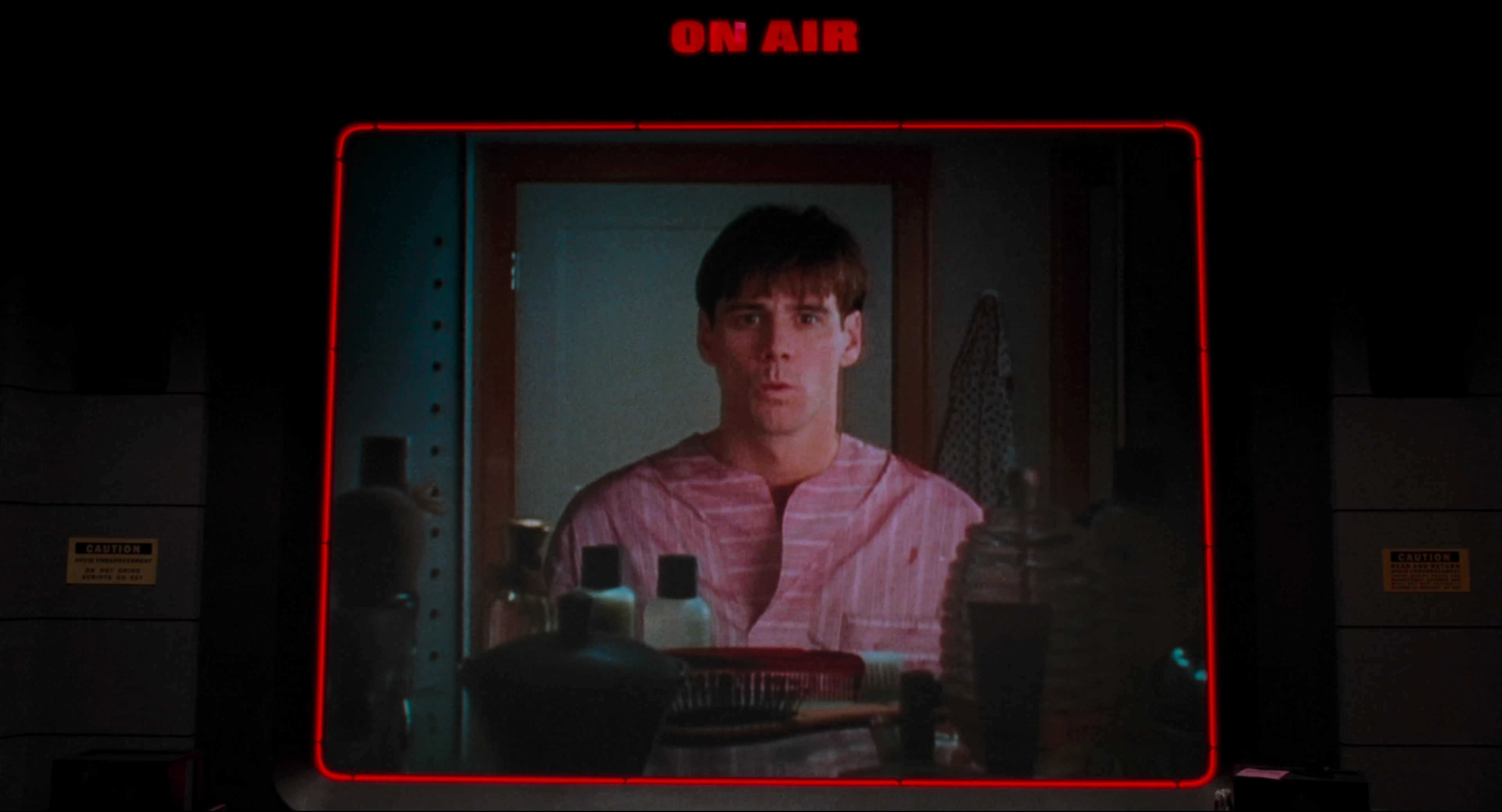
The Truman Show – Still 710
Pending Play Grading
| Criteria | Scores | Our Score |
| Acting | 1 – 5 | 5 |
| Script | 1 – 5 | 4 |
| Cinematography | 1 – 5 | 4 |
| Soundtrack | 1 – 5 | 4 |
| Originality | 1 – 5 | 5 |

"Good morning, and in case I don't see ya: Good afternoon, good evening, and good night!"
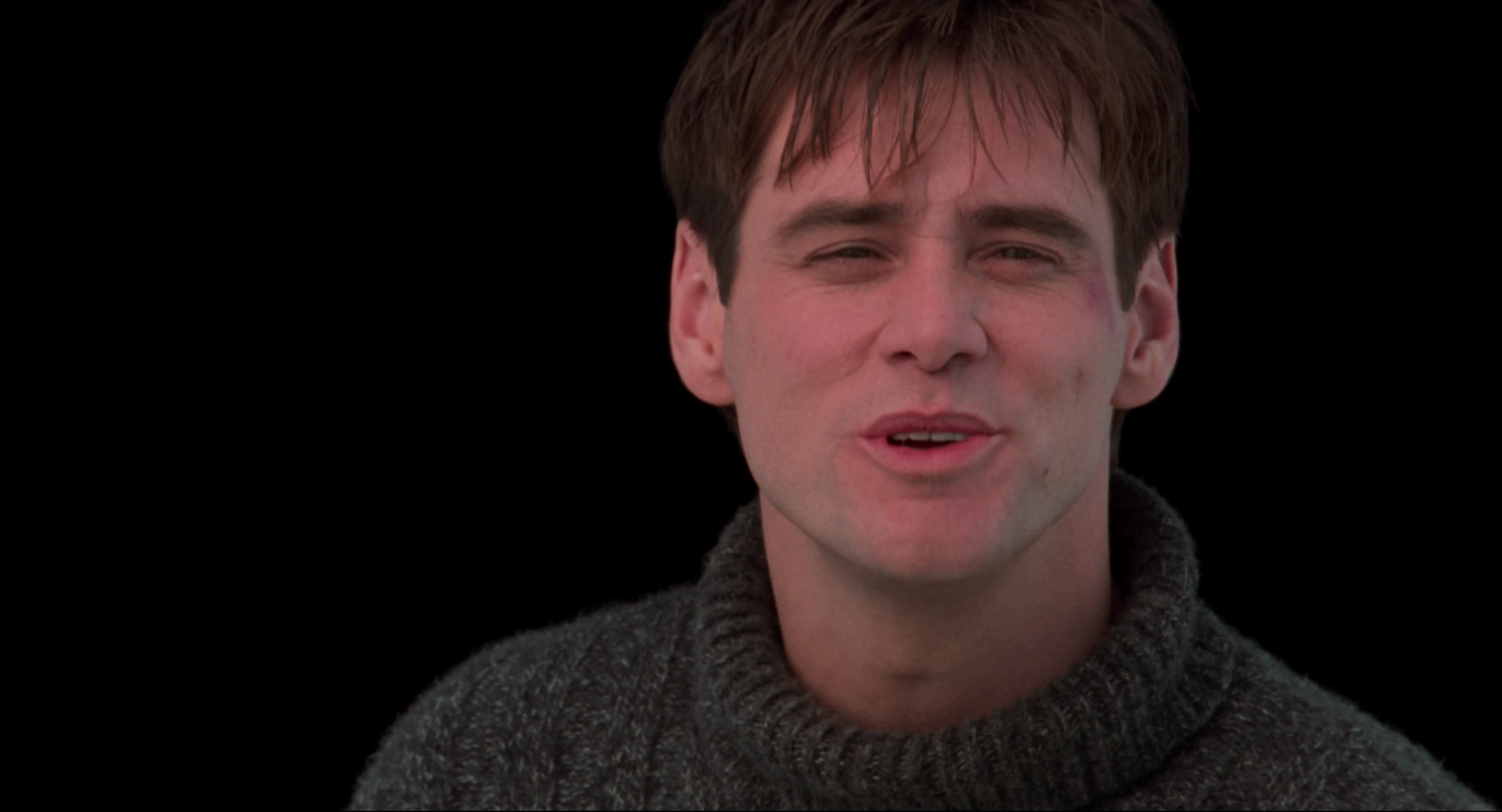
The Truman Show – Still 8 11

Written By: JustM
About: I have loved all sorts of media for most of my life. Not only consuming it, but also analysing it, really diving into it; at least as long as I enjoyed the media.
There isn’t a specific type of media or genre that I focus on. As long as I am remotely interested, I’ll watch or read it. However, the stories I have come to enjoy most are those with good character writing and a focus on connection and relationships (bonus if they have some form of unlikely friendship).
So if you have a recommendation, feel free to tell me. My watchlist and TBR are long, but there is no shame in making them longer.
Donate: paypal.me/maraTrN
You can also find me on:
Instagram/Threads: @i.m_just_m_ | letterboxd: @JustM | Storygraph: @im_just_m
Sources
- Cambridge Dictionary (https://dictionary.cambridge.org/dictionary/english/freedom) [last visited: 18.05.2026] ↩︎
- Schneider, Yvonne; Alberty, Vicotry (n.a.): Konzepte von Freiheit. RWTH Aachen University (https://philou.rwth-aachen.de/konzepte-von-freiheit) [last visited: 18.05.2026] ↩︎
- The Truman Show. Poster (https://letterboxd.com/film/the-truman-show/) [last visited: 28.05.2026] ↩︎
- The Truman Show. Still 1 (https://stillslab.com/gallery/the-truman-show) [last visited: 28.05.2026] ↩︎
- The Truman Show. Still 2 (https://stillslab.com/gallery/the-truman-show) [last visited: 28.05.2026] ↩︎
- The Truman Show. Still 3 (https://stillslab.com/gallery/the-truman-show) [last visited: 28.05.2026] ↩︎
- The Truman Show. Still 4 (https://stillslab.com/gallery/the-truman-show) [last visited: 28.05.2026] ↩︎
- The Truman Show. Still 5 (https://stillslab.com/gallery/the-truman-show) [last visited: 28.05.2026] ↩︎
- The Truman Show. Still 6 (https://stillslab.com/gallery/the-truman-show) [last visited: 28.05.2026] ↩︎
- The Truman Show. Still 7 (https://stillslab.com/gallery/the-truman-show) [last visited: 28.05.2026] ↩︎
- The Truman Show. Still 8 (https://stillslab.com/gallery/the-truman-show) [last visited: 28.05.2026] ↩︎
Discover more from Pending Plays
Subscribe to get the latest posts sent to your email.



I love your post aesthetic! Reminds me of Amino :3
Thanks. I loved the layout possibilities on Amino, and I was so happy when I saw that I could create a similar layout here. ;]
Also it’s been 10+ years since I’ve seen the film, but I’d say I agree with most of your points~